Author: admin

  • Biogas flow measurement & recording in a reputed Starch industry, Gujarat

    Biogas flow measurement & recording in a reputed Starch industry, Gujarat

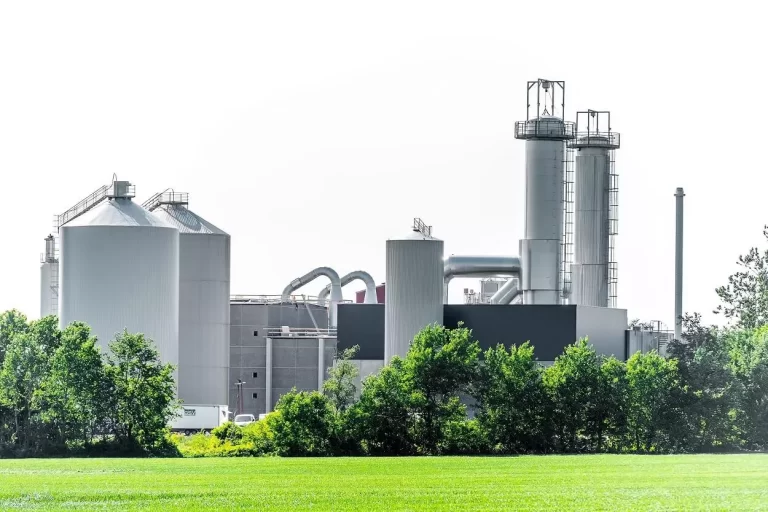
    Starch plant

    Problem

    Starch products are produced from corn processing. The process effluent waste water produces Biogas as a by-product with the help of the fermentation process. Biogas produces waste-gas (Biogas flow measurement) used for heating boilers and generators for energy conservation.

    • Biogas is generated at very low static pressure approx. 800mmwc to 1200 mmwc.
    • Biogas generate with low velocity & contains high moisture content ( 3%-5%Vol)
    • Existing orifice/ vortex flow meter doesn’t work at low flow rates.
    • Existing orifice / vortex flowmeter creates high pressure drop so have to increase pressure by the blower system with additional investment

    Solution

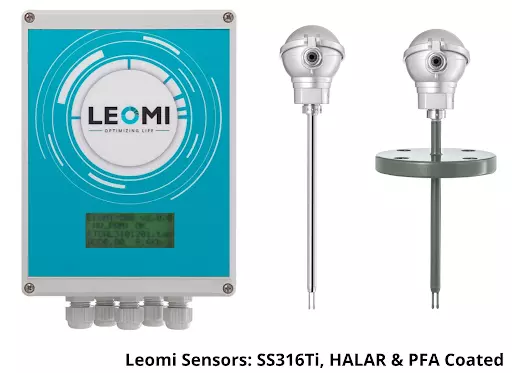
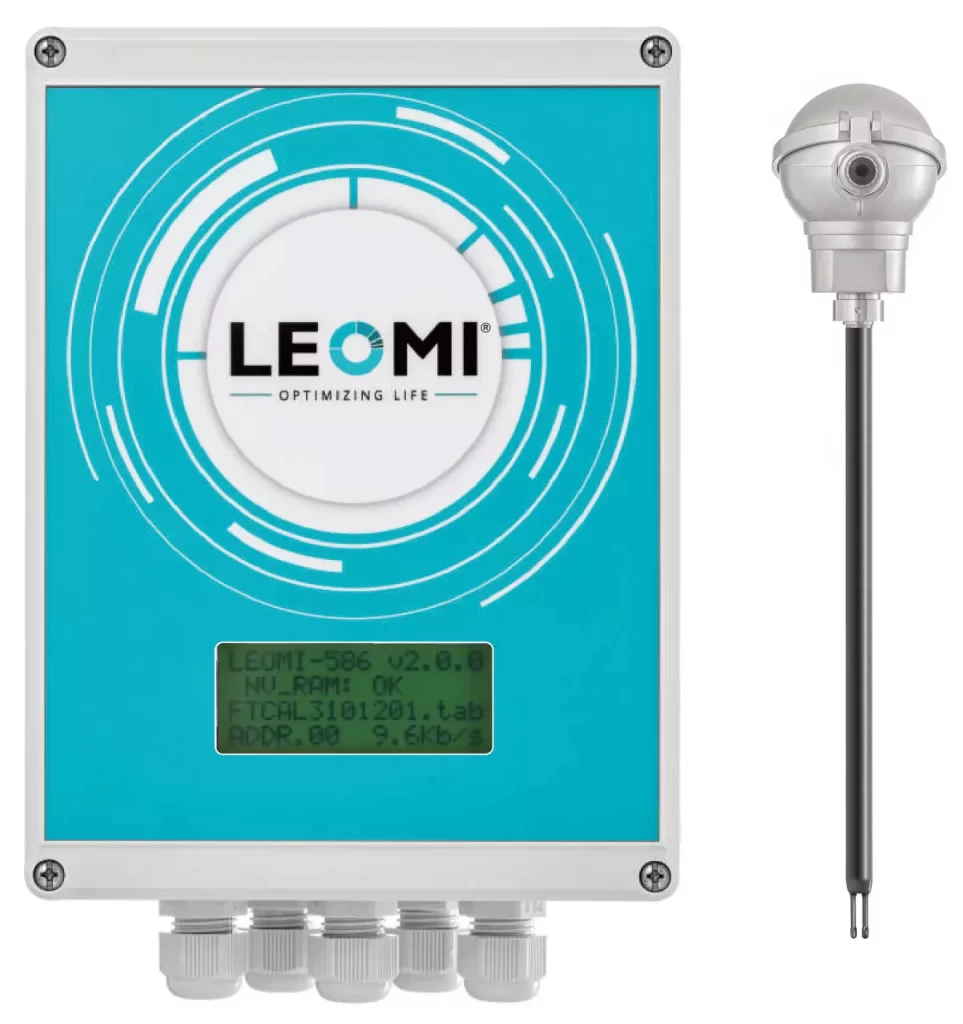
    Leomi – 586 Insertion Thermal Mass flowmeter

    • High turndown down ratio of 100:1 against 4:1 of existing installation.
    • No pressure drop against the existing flow meter can be installed after the gas holder, saving energy cost by removing the blower system.
    • High accuracy against orifice/ vortex flowmeter
    • Works well even in high moisture content
    • Doesn’t require shutdown for installation
    • No maintenance than the existing flow meter used.

    Customer

    Highly reputed starch plant, Gujarat

    Product

    LEOMI- 586, Insertion Thermal Mass Flowmeter

    Why Leomi?

    • An ISO 9001:2015 company, Startup India recognized
    • German technical collaboration Engineered in India
    • India’s First In-house fully automatic wind tunnel calibration system
    • Product quality proven for more than 20 years installed worldwide.

    Installation Facts

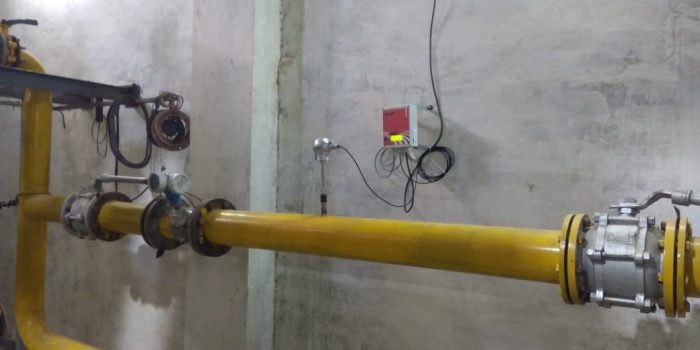
    biogas flow measurement

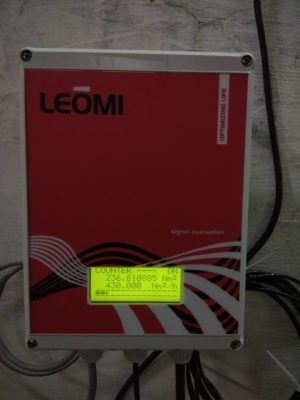
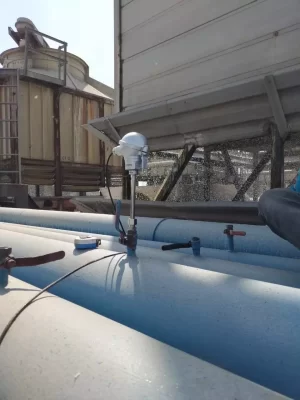
    Leomi 586 is installed in the biogas generation pipeline after a gas holding tank in 6” (DN100) pipe with flow rates of 600Nm3/hr range. Works even in high moisture conditions and at very low flow rates upto 3 Nm3/hr as well. Working trouble free since year May’2019 at customer site.

    leomi mass flow meter

    Download the Complete Case Study: Biogas Flow Measurement


    Download

  • HVAC system air flow monitoring in nuclear power plant

    HVAC system air flow monitoring in nuclear power plant

    Airflow monitoring in nuclear power plant

    In a Air Flow Monitoring in Nuclear Power Plant

    efficient HVAC systems supply & exhaust airflow rate plays an important
    role in monitoring the release of air from controlled areas and contain any
    radioactivity that might be released in the event of a malfunction, failure, or
    accident.

    The high sensitive thermal mass flow meter is an
    ideal choice & detects leakages from the duct.

    HVAC system is of utmost importance considering
    safety & smooth operations by maintaining ambient conditions within
    acceptable limits.

    In addition, these systems help protect staff
    and equipment from specific risks inside the buildings, such as explosions or
    fire.

  • Pros & Cons of Coriolis Flow Meter

    Pros & Cons of Coriolis Flow Meter

    gas flow measurement technologies

    Pros and Cons of different gas flow measurement technologies available in the market which will help process instrumentation engineers to effectively choose best flow metering technology for defined application which results in optimum results w.r.t cost versus performance ratio.

    Process instrumentation engineer’s task is to identify which of the Mass flow meter technology will be best suitable technology.

    Below are some important factors to be considered & evaluated with comparing technologies for  ptimum selections:

    • Pipe sizes
    • Process conditions such as flowrate, pressure, temperature, density, viscosity, dirt & moisture etc.
    • Installation conditions such as horizontal, vertical or inclined & available straight lengths, time & efforts etc.
    • Accuracy & repeatability needed
    • Process turndown ratio needed
    • Budgeted price

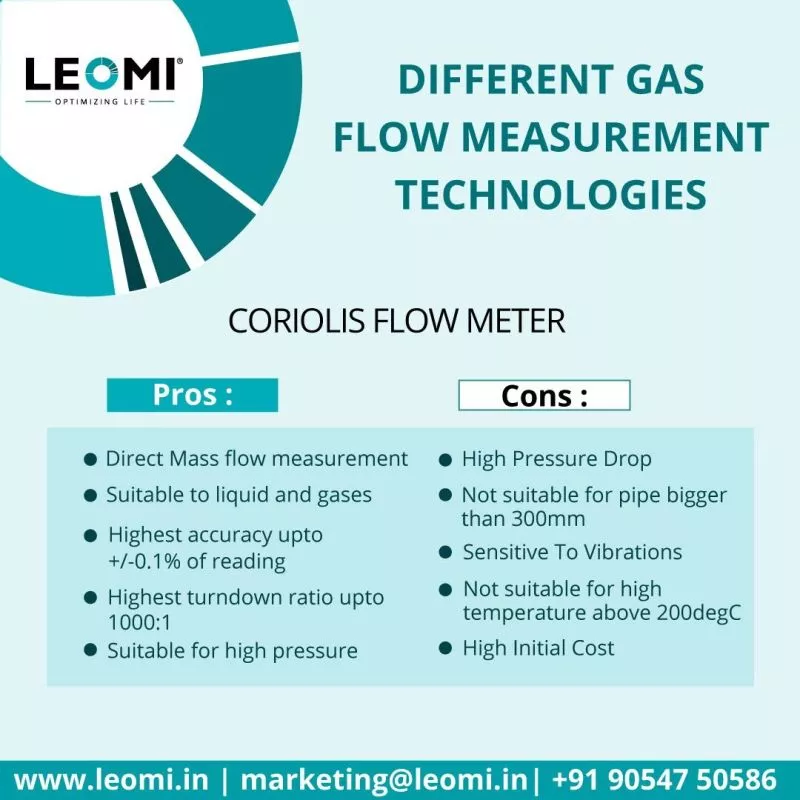
    Here are the advantages and disadvantages of Coriolis Flow Meter.

    Pros :

    1. Direct Mass Flow Measurement
    2. Suitable to Liquid and Gases
    3. Highest accuracy
    4. Highest turn down ratio
    5. Suitable for high pressure

    Cons :

    1. High-pressure drop
    2. Sensitive to vibrations
    3. Not suitable for high temperature
    4. High initial cost
  • Compressed Air consumption monitoring in one of the world’s largest textiles plant

    Compressed Air consumption monitoring in one of the world’s largest textiles plant

    leomi compressed air flow meter in india

    Problem

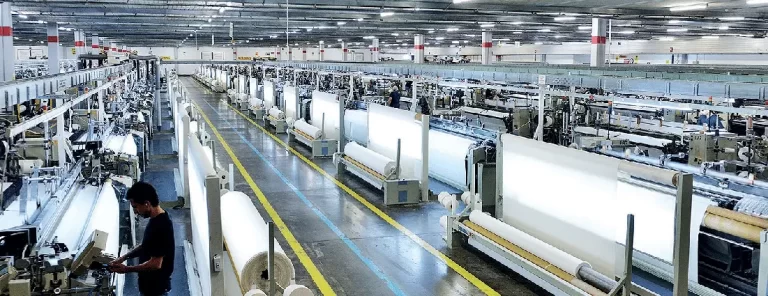
    Textile industry is complex in nature.

    • Air jet Looms & Winding Machines are major consumers.
    • Negligence in machine specification selection- uncertain compressed air demand
    • In Composite textiles – Synchronization is a big challenge for high & low pressure.
    • Existing Vortex & Orifice flowmeters unable to record low flowrate consumption.
    • Have high pressure drop upto 3 psig which creates an energy loss.
    • Unable to identify compressed air leakage in various departments.

    Solution

    Leomi – 586 Insertion Thermal Mass flowmeter

    • Doesn’t require shutdown for installation
    • High turndown down ratio of 100:1
    • No pressure drop against existing flow meter installed saves energy cost
    • Allows leakage detection with better accuracy
    • No maintenance than the existing flow meter used.

    Application

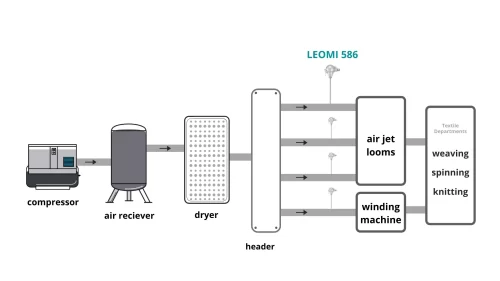
    Compressed air consumption monitoring and recording in air jet Looms & Winding machines.

    Customer

    World’s biggest Textile plant, Gujarat

    Product

    LEOMI- 586, Insertion Thermal Mass Flowmeter

    Why Leomi?

    • An ISO 9001:2015 company, Startup India recognized
    • German technical collaboration Engineered in India
    • India’s First In-house fully automatic wind tunnel calibration system
    • Product quality proven for more than 20 years installed worldwide.

    Installation Facts

    compressed airflow meter in textile

    Leomi 586 is installed in the main branch of the different departments on 12” (DN300) pipe with 6000 SCFM flow rate with isolation ball valve providing easy removal. They are monitoring more than 150 Airjet looms and winding machines and have been used by customer for more than 3 years. Solved consumption problems of different departments. Payback in less than 6 months.

    insertion mass flowmeter in india

    leomi 586 thermal mass flow meter

    Download the Complete Case Study


    Download

  • How Selecting the right flowmeter can help you minimize your annual energy costs

    How Selecting the right flowmeter can help you minimize your annual energy costs

    airflow meter in india

    The pace of the liquid stream establishes a significant estimation in the handling enterprises.

    Choosing a fitting innovation for a stream estimation application can subsequently be an overwhelming assignment. With such a wide assortment of innovations on offer, it very well may be hard to track down the best one for a specific application. Les Slocombe, for ABB Measurement Products UK, clarifies how finding the flowmeter that can make the greatest commitment to limiting energy expenses can assist with restricting the choice.

    The broad decision of stream innovation choices on proposition can make choosing the right flowmeter for an application a stupefying assignment. A wide scope of variables can impact air flow meter choice, of which cost is only one. Flowmeters dependent on differential strain opening plates, spouts, wedges, Venturis, and Pitot tubes present a limitation in the stream. The unrecoverable strain misfortune brought about by the limitation is a proportion of the volumetric stream rate. Positive removal flowmeters are valid volumetric stream gadgets, estimating the real liquid volume that goes through a meter body with no worry for speed. These flowmeters catch a particular volume of liquid and pass it to the power source. The liquid tension moves the system that exhausts one chamber as another fills.
    In case the application requires a proportion of the mass stream rate, volumetric flowmeters should be enhanced with extra data, like liquid thickness, pressure, as well as temperature. Some multivariable flowmeters and transmitters fuse an extra sensor to give this data. Then again, Coriolis flowmeters (and warm tests for gas) straightforwardly measure mass stream rate. With a current portion of the overall industry of around 18%, they are consistently tracking down their direction into an expanding scope of utilizations. Many flowmeter technologies introduce pressure loss into a system. Pressure losses equate to energy losses and costs. Valves, pipe friction, reducers, expanders, and measuring devices such as flowmeters all increase the Permanent Pressure Loss (PPL) in the system. Some flowmeters require upstream reducers and downstream expanders to operate properly. For new processes, engineers often consider PPL when designing a system because it’s important in sizing the pump (liquids), compressor (gases), or boiler (steam) to meet process conditions and to deliver the desired pressure and/or flow. For operating processes, PPL leads directly to the need for compensating energy, which can equate to significantly increased annual operating costs. By minimizing pressure losses in a process, engineers can cut the need for top-up pumping or compression as well as environmental impact. In the case of steam boilers, which are expensive, the ability to retrofit existing flowmeters with those having low-pressure losses can boost the effective boiler capacity.

    By selecting air flow meters with low-pressure losses, engineers can:

    – Reduce pumping/compressing cost
    – Increase capacity
    – Minimize compressor, pump, or boiler size. The amount of pressure loss in a flowmeter depends on three factors: the fluid density, the square of the fluid velocity (Vf)2, and the degree of obstruction to fluid flow, (Kmeter).

    The following list roughly ranks the magnitude of the Kmeter factor for various air flow meters, from greatest pressure loss to lowest.

    1. Coriolis
    2. Orifice/Nozzle
    3. Turbine
    4. Vortex
    5. Venturi
    6. Averaging Pitot tube
    7. Electromagnetic/Ultrasonic (negligible PPL)

    Replacing an orifice plate with an averaging Pitot tube, for example, can reduce the permanent pressure loss (energy requirement) by a factor of 20. Averaging Pitot tubes offer minimal irrecoverable pressure losses as well as being inexpensive and simple to install.

  • Pros & Cons of Thermal Mass Flow Meter

    Pros & Cons of Thermal Mass Flow Meter

    gas flow meter in India

    Pros and Cons of different gas flow measurement technologies available in the market which will
    help process instrumentation engineers to effectively choose the best flow metering technology for defined application which results in optimum results w.r.t cost versus performance ratio.

    Process instrumentation engineer’s task is to identify which of the Mass flow meter technology will be the best suitable technology.

    Below are some important factors to be considered & evaluated with comparing technologies for optimum selections:

    – Pipe sizes
    – Process conditions such as flow rate, pressure, temperature, density, viscosity, dirt & moisture, etc.
    – Installation conditions such as horizontal, vertical or inclined & available straight lengths, time & efforts etc.
    – Accuracy & repeatability needed
    – Process turndown ratio needed
    – Budgeted price

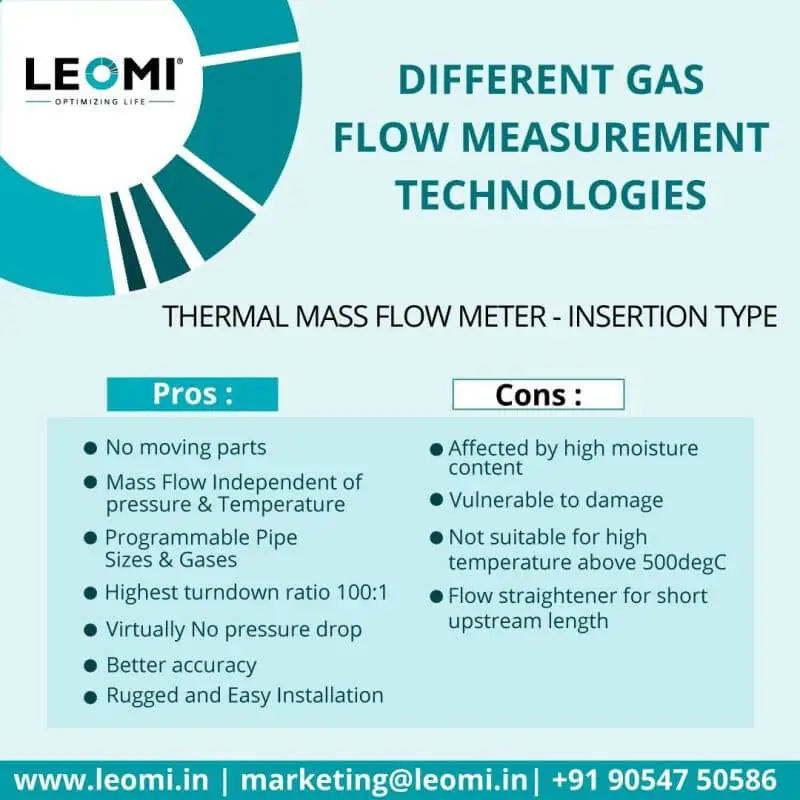
    Here are the pros and Cons of Thermal Mass Flow Meter – Insertion Type

    Pros:
    1. No moving parts
    2. Independent mass flow
    3. Pipe size
    4. Highest turndown ratio
    5. Virtually no pressure drop
    6. Better accuracy
    7. Easy installation & rugged

    Cons:
    1. Affected by high moisture content
    2. Vulnerable to damage
    3. Not suitable for high temperature
    4. Flow straightener for short upstream length

  • Pros & Cons of Turbine Flow Meter

    Pros & Cons of Turbine Flow Meter

    Pros and Cons of different gas flow measurement technologies available in the market which will help process instrumentation engineers to effectively choose best flow metering technology for defined application which results in optimum results w.r.t cost versus performance ratio.


    Process instrumentation engineer’s task is to identify which of the Mass flow meter technology will be best suitable technology.


    Below are some important factors to be considered & evaluated with comparing technologies for optimum selections:


    – Pipe sizes

    – Process conditions such as flowrate, pressure, temperature, density, viscosity, dirt & moisture etc.

    – Installation conditions such as horizontal, vertical or inclined & available straight lengths, time & efforts etc.

    – Accuracy & repeatability needed

    – Process turndown ratio needed

    – Budgeted price


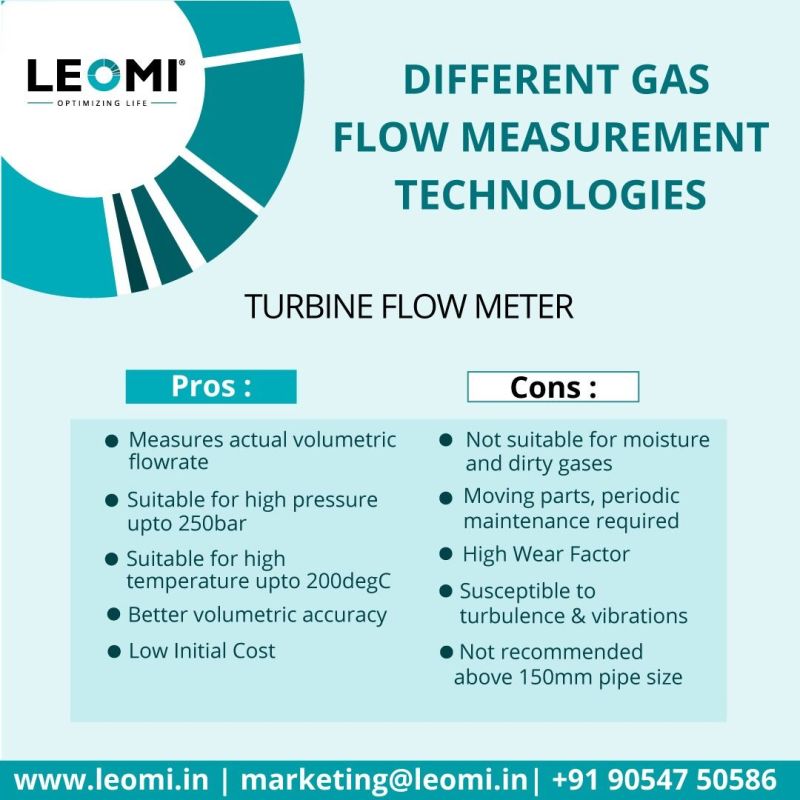
    Here are the Pros and Cons of a Turbine Flow Meter :


    Pros :

    1. Derives Volumetric Flow rate

    2. High accuracy

    3. Orientation Flexible

    4. Low Initial Cost

    5. Suitable High pressure


    Cons :

    1. Dry and Clean Gas

    2. Susceptible to Vibrations

    3. High wear factor


  • Pros & Cons of Ultrasonic Flow Meter

    Pros & Cons of Ultrasonic Flow Meter

    Pros and Cons of different gas flow measurement technologies available in the market will help process instrumentation engineers to effectively choose best flow metering technology for defined application which results in optimum results w.r.t cost versus performance ratio.

    Process instrumentation engineer’s task is to identify which of the Mass flow meter technology will be best suitable technology.

    Below are some important factors to be considered & evaluated with comparing technologies for optimum selections:

    – Pipe sizes
    – Process conditions such as flow rate, pressure, temperature, density, viscosity, dirt & moisture, etc.
    – Installation conditions such as horizontal, vertical, or inclined & available straight lengths, time & efforts, etc.
    – Accuracy & repeatability needed
    – Process turn down ratio needed
    – Budgeted price

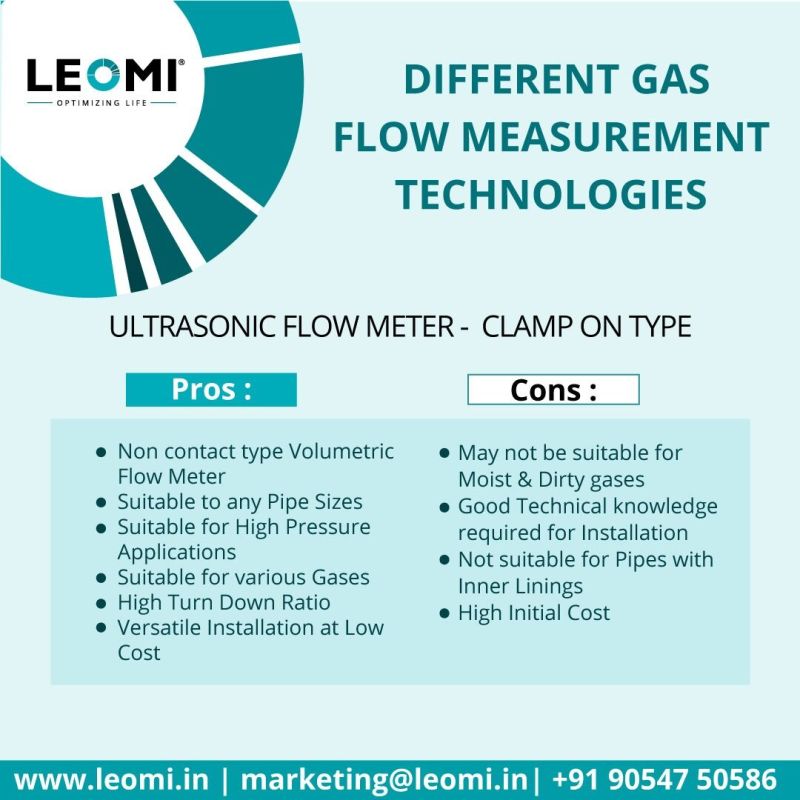
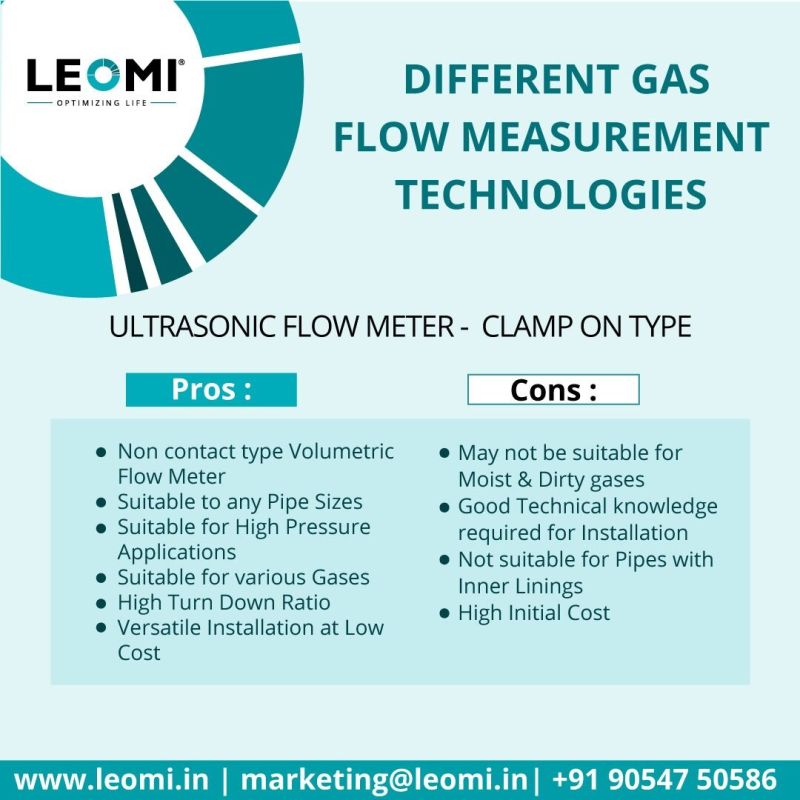
    Here are the Pros and Cons of Ultrasonic Flow Meter- Clamp-on Type

    Pros :
    1. Non-contact type volumetric flow meter
    2. Suitable 5o any pipe sizes
    3. Suitable to high pressure
    4. High turn down ratio

    Cons :
    1. May be not Suitable for moist and dirty gases
    2. High initial cost
    3. Most Suitable for pipes with inner lining

  • Pros & Cons of Vortex Flow Meter

    Pros & Cons of Vortex Flow Meter

    Pros and Cons of different gas flow measurement technologies available in the market which will help process instrumentation engineers to effectively choose best flow metering technology for defined application which results in optimum results w.r.t cost versus performance ratio.

    Process instrumentation engineer’s task is to identify which of the Mass flow meter technology will be best suitable technology.

    Below are some important factors to be considered & evaluated with comparing technologies for optimum selections:

    – Pipe sizes
    – Process conditions such as flowrate, pressure, temperature, density, viscosity, dirt & moisture etc.
    – Installation conditions such as horizontal, vertical or inclined & available straight lengths, time & efforts etc.
    – Accuracy & repeatability needed
    – Process turndown ratio needed
    – Budgeted price

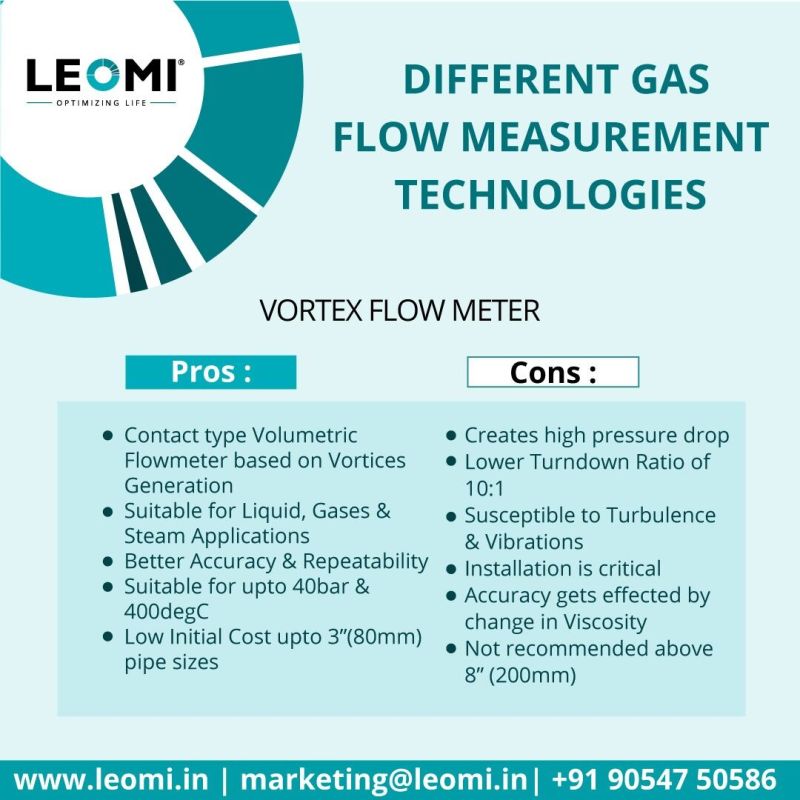
    Here are the Pros and Cons of Vortex Flow Meter

    Pros :
    1. Suitable for liquid, gases and steam applications
    2. Better accuracy and repeatability
    3. Low initial cost
    4. Suitable upto 40 bar

    Cons :
    1. Creates high pressure drop
    2. Susceptible to turbulent and vibration
    3. Accuracy gets affected due to viscosity

  • Types of Thermal Mass Flowmeter Technologies

    Types of Thermal Mass Flowmeter Technologies

    Types-of-Thermal-Mass-Flow-Meter-Technologies leomi

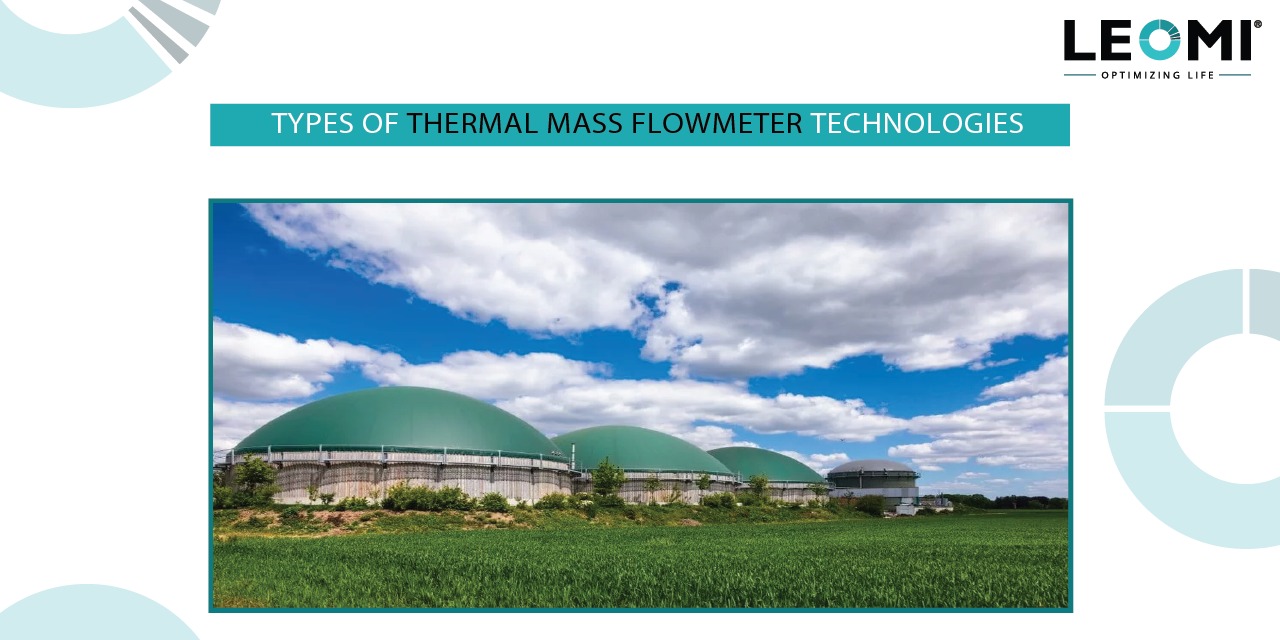
    Within this blog, we will discuss the different types of thermal mass flowmeter technologies. Thermal mass flowmeters operate on the principle where a heat source is applied to the inlet of the mass flow meter and is then transmitted from one part of the device to another, increasing in temperature (gain an amount of q) based on its thermal resistance.

    The change in temperature as a function of time causes a corresponding change in thermal conductance (change in convective heat transfer coefficient h). As fluid flows through a pipe it changes its speed due to frictional forces and if there is a thermocouple placed at various points within this pipe can determine how much varying thermal power dissipation occurs within that length by relating it back to a known conduit’s temperature gradient.

    Let us discuss the types of thermal mass flowmeters:

    1. Insertion Thermal mass flow meter

    if we have large pipes and don’t want to cut them, then maybe we can use an insertion thermal mass flow sensor. Rather than cutting the pipe, an insertion sensor is inserted into the pipe between two flanges. This one’s easy to install, comes in different sizes and measures the heat of flowing gas. Therefore it doesn’t require a calibration gas, has no moving parts, is unaffected by shock cycling and vibration.

    To find out the total mass flow within the pipe, this sensor factors in the flow rate, compensation and cross-section of your pipe and pressure drop across a specified range by using carefully selected numerical algorithms that are run on a microcontroller. When we scale out a new insertion sensor, we need to make sure that it goes in line with a length of pipe where there won’t be any measurement problems such as where the customer had entered data for the wrong size pipe or inserted the sensor incorrectly.

    2. Bypass Thermal mass flow meter

    Below you can see two names for this device. We call it either a bypass flow meter or a capillary tube flow meter. This type has a laminar flow element and includes an inlet and outlet for the capillary tube where the fuel flows during its cycle. The capillary tube houses all the components of the system, including the transducer and heating coil, but keep in mind that each vendor can have their own variation of it. For example, some may provide up to 3 sensors while others may use 2 heating systems depending on what their design offers.

    This permits you to get more information out of your fuel data such as oxygen content to help determine whether there is any contamination present during transport or storage.

    3. Inline Thermal mass flow meter

    This product has a lightweight, yet aerodynamic shape. It combines the advanced sensor and transmitter in patented packaging. It contains several components such as aluminum, plastic, and fiberglass composites. Due to its cylindrical design, this shell gives the thermal dispersion required at different speeds.

    Why insertion thermal mass flow meter is a better choice?

    Insertion Thermal Mass Flow Meter is a widely used process instrument that is used for measuring volumetric flow rate and thermal conductivity of the materials that are flowing through the process. The fact that an Insertion Thermal Mass Flow meter is a type of thermal mass flow meter, which is thermally compensated for temperature effects in process flow systems, makes it ideal for detecting process flow deviations.

    Moreover, Insertion Thermal Mass Flowmeter is a one-time measurement and substitutes the direct reading of flow rate from multiple instruments. Originally developed for the pharmaceutical industry, it was widely adapted to process equipment such as mixing chambers, reactors, and distillation columns over time.

    Thermal mass flow meters are mainly used in large volume process equipment where the measured temperature change is sufficiently small to be quantifiable. While Insertion Thermal Mass Flowmeter can only provide a reliable estimate of thermal conductivity which varies with time during certain processes, it may give more accurate measurements due to its ability to capture steady-state conditions than other instruments such as paddle wheel meters or rotameters during certain processes. This makes it a great choice for system control, detection of deviations, and measuring plant improvements related to mass flow rate.

    Leomi’s Insertion Thermal Mass flowmeter

    Leomi aims to optimize everyday life with a higher standard of living by manufacturing high-quality Thermal mass flow meters with years of industry experience. Leomi combines decades of experience at Softflow.de in the field of thermal flow measurement and provides reliable meters for customers worldwide!

    Leomi thermal mass flowmeter offer benefits such as:

    • No moving parts, robust metallic construction, and direct mass flow measurement of gases
    • No pressure drop which saves energy against other conventional flowmeters
    • The highest turn down-ratio better than 100:1 provides high sensitivity helps in leak detection
    • High accuracy <±1.5% and resolution against conventional flow meters.
    • Designed up to 400⁰C operating temperature and pressure up to 16bar or higher.
    • Easily cleanable sensor & No significant effect of moisture like thin-film sensor does.
    • Can work in dirty or wet gas environments with accessories
    • Adjustable in various pipe sizes and versatile for different gas and mixtures.
    • Digital controlled with No drift and long term mechanically stable design

    LEOMI’s technical team is continuously working on researching different gas mass flow measurement solutions for various industries that can be implemented while keeping in mind both process and industrial standards.

    Request to kindly write us your inquiry related to the above application and will happy to assist with flow solutions at our best. For more information, log on to https//www.leomi.in & follow us on our LinkedIn page for more updates.