
Previous slide
Next slide
Insertion Thermal Mass Flow Meter | German Technology Engineered in India
COMPANY OVERVIEW
A continuous endeavour of more than two decades into the field of technologies and automation has inspired LEOMI Founders to start a manufacturing venture looking into the industrial measurement solutions (Insertion Thermal Mass Flow Meter) that optimizes life. LEOMI provides affordable and reliable solutions with the hands on expertise of MTS Engineers Pvt Ltd that has fueled reputed companies for industry specific technologies.
LEOMI strive to hunt industries’ rugged conditions for optimization of industrial processes with German standards of softflow.de in Gandhinagar, Gujarat. LEOMI is an 9001:2015 company that ensures products and services meet the needs of clients through an effective quality management system.
PRODUCTS
Services
INDUSTRY
Application
MEASUREMENT PRINCIPLE
LEOMI calorimetric Insertion Thermal Mass Flow Meter work on the physical principle of thermal dispersion from a heated element to the ambient medium (eg. air or gases). This is affected by the velocity, density (temperature and pressure), and by the characteristic of the medium. The amount of needed energy is a function of the temperature difference ∆T and the mass flow.
Gas flows through two RTD Pt-100 one reference (Tref) and the other Heater (Th). The temperature difference (over-temperature) ∆t between the reference sensor (medium temperature) and the heater sensor is controlled constantly. As per King’s Law, the higher the mass flow rate, the higher the cooling effect of the heater sensor, thus higher the power required to maintain the differential temperature constant. Therefore the heater power is proportional to the gas mass flow rate.
As we can see besides, there is a correlation between velocity (m/s) and power (mW) of the flow. If the velocity increases, power increases and vice-versa. And when the velocity starts to decrease, the power will simultaneously decrease. We have shown here velocity 0-70 m/s and power 100-1000mW. The bubbles in the pipe indicate air or gas flow. In which, the red bubbles show the heating effect on flow by the heater sensor.
https://test.leomi.in/wp-content/uploads/2022/01/insertion-thermal-mass-flow-meter.mp4
Insertion Thermal Mass
Flow Meter Utilizing the
heat dissipation principle
WHY LEOMI INSTRUMENTS?
LEOMI Instruments has developed ways to optimize your existing air & gas flow measurement systems. LEOMI has commissioned India’s first in-house latest State-of-the-art Wind Tunnel, Made in Germany for Air Velocity Calibration and anemometer calibration services. It is certified as per ISO-17025 and DAkkS Germany traceability for airflow velocity ranges from 0.2 m/s to 75 m/s with flow uniformity of ±0.2%. LEOMI insertion thermal mass flow meter utilizes a combination of analog controller for high resolution & quick action and digital controller for very high absolute accuracy and long-term stability against the disadvantages of a Wheatstone Bridge. It uses advanced technology which has a robust & rugged flow-sensor design with Pt-100 RTD ceramic wire-wound sensor which provides stable output without any drift and is mechanically stable.
News & Articles
Overcoming Measurement Challenges: Thermal Mass Flow Meters in Moist Flue Gas Environments

Customizable and Cleanable Sensors in Steel Industry Applications: Benefits of Advanced Flow Meters

Ensuring Quality in Man-Made Fiber Production: Measuring Air Flow in POY and FOY Processes

Improving Milk Powder Drying with Hot Air Flow Monitoring by Leomi

The Role of Flow Meters in the Blast Furnace and Basic Oxygen Furnace (BF-BOF) Steelmaking Process

Enhancing Spinning Processes: The Role of Flow Meters in Ring, Open-End, and Air Jet Spinning
Media Publications
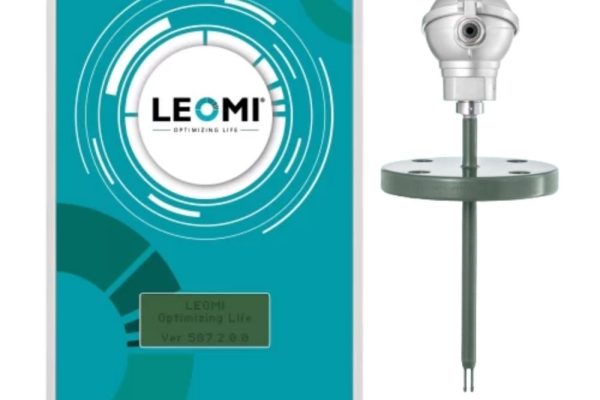
New Product Launch LEOMI 587 for Actual Mass/ Volume Flow measurement – Issuwire
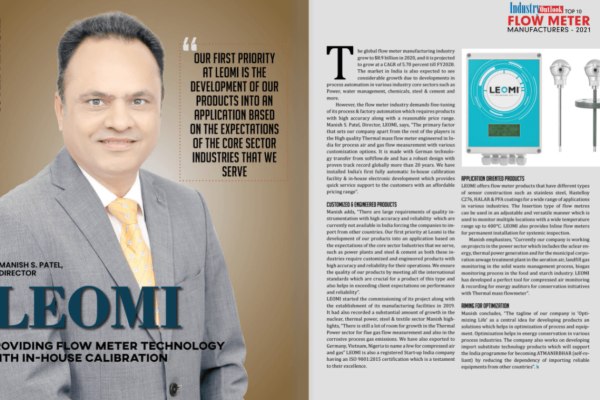
Leomi providing flow meter technology with in-house calibration – The Industrial Outlook
Frequently Asked Questions
How do you maintain and calibrate a thermal mass flow meter?
Maintaining a thermal mass flow meter involves regular cleaning to prevent sensor contamination and periodic calibration to ensure accuracy. Calibration should be performed using certified calibration equipment and standards. Many manufacturers offer third-party calibration services, rental agreements, and annual maintenance contracts to help maintain the performance and reliability of the thermal mass flow meters.
Why choose Leomi Technologies for Mass Flow Meters in India?
Leomi Technologies offers cutting-edge flow measurement solutions with German engineering precision, tailored for rugged industrial environments in India. Our products are ISO 9001:2015 certified, ensuring high quality and reliability.
How does a Thermal Mass Flow Meter differ from other flow meters?
Thermal Mass Flow Meters measure the mass flow rate of a gas directly, without needing temperature or pressure compensation. They are unique because they offer high accuracy and low maintenance in various gas flow measurement applications.
Why choose LEOMI’s flow meters for industrial applications?
LEOMI’s flow meters are engineered with advanced technology and high-quality standards to ensure precise and reliable measurements. Our range of flow meters is versatile, catering to various industrial needs, including high-temperature and biogas applications, making them a preferred choice for diverse sectors.
How does a Thermal Mass Flow Meter work?
Thermal Mass Flow Meters measure the mass flow of gases directly by detecting the amount of heat absorbed or shed by a gas as it passes over a heated element. This technology ensures precise measurement without the need for additional pressure or temperature compensation.
What support and services does LEOMI offer for its flow meters?
LEOMI provides comprehensive support and services, including third-party calibration services, rental agreements, annual maintenance contracts, and technology verification initiatives. Our dedicated team ensures prompt and efficient service to maximize the performance of our flow meters.
What are the benefits of using an Inline Thermal Mass Flow Meter?
They provide high accuracy, low maintenance, and no moving parts, resulting in a reliable measurement solution for monitoring and controlling gas flow in many industries, including energy, manufacturing, and environmental monitoring.
Can Bio Gas Flow Meters be used in renewable energy applications?
Yes, Bio Gas Flow Meters are specifically designed to measure the flow rate of biogas, which is crucial in renewable energy applications. They ensure efficient monitoring and control of biogas production, a key factor in optimizing renewable energy systems.
What is an Inline Thermal Mass Flow Meter?
An Inline Thermal Mass Flow Meter measures the mass flow rate of gas or air directly in the pipeline. It offers accurate readings without the need for separate temperature or pressure inputs, making it ideal for various industrial applications.
What advantages do insertion thermal mass flow meters offer for biogas measurement?
These meters are valued for their accuracy, ease of installation, minimal maintenance, and ability to perform under varying temperature and gas composition conditions. They don’t require additional components for pressure or temperature correction.
What industries benefit most from using thermal mass flow meters?
Thermal mass flow meters are widely used in industries such as thermal power, steel, textile, automobile, cement, chemical, fertilizers, food and beverage, pharmaceuticals, and oil and gas. These meters offer precise gas flow measurements crucial for process optimization, emissions monitoring, and energy management in these sectors.
What is a Compressed Air Flow Meter and how does it work?
A Compressed Air Flow Meter measures the quantity of compressed air used in industrial or commercial applications. It operates on the principle of thermal mass flow measurement, providing accurate readings of air flow rates.
What is an Insertion Thermal Mass Flow Meter?
An insertion thermal mass flow meter is a device used to measure the mass flow rate of a gas in large-diameter pipes or ducts. It operates on the principle of thermal dispersion, providing accurate and reliable readings essential for various industrial applications.
What is the role of biogas in renewable energy?
Biogas, created from organic waste, serves as a renewable energy source, contributing to energy sustainability and waste management.
How does an Inline Thermal Mass Flow Meter work?
This device operates on the principle of thermal dispersion. It measures the mass flow rate by calculating the amount of heat absorbed or lost by the flowing gas, which correlates directly to the mass flow rate.