Category: Articles

Stay updated with the latest Air flow meter market news, Global Market Share, Trends, Analysis, and Forecasts with LEOMI Instruments.

  • 5 Factors that Crucial For Insertion Thermal Mass Flow Meter Performance

    5 Factors that Crucial For Insertion Thermal Mass Flow Meter Performance

    This article talks about the basics of flow profiles, installation criteria, end-user application considerations, and how to use flow conditioning to improve the accuracy of the insertion thermal mass flow meter in areas where a sufficient flow profile isn’t possible.
    insertion thermal mass flow meter

    Number- 1: Understanding velocity profile

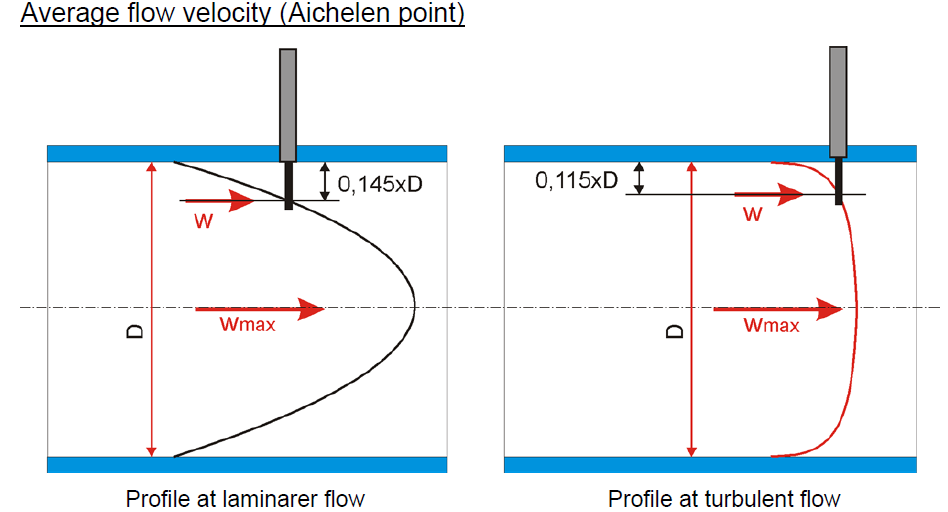
    Inside a pipe, fluids, such as gas, flow at different speeds. When gas flows through a circular pipe, particles in contact with surface of pipe wall come to a halt (W0), forming a boundary layer. To maintain the mass flow rate through the pipe, the gas velocity in adjacent layers slows due to friction and the gas velocity in the midsection increases at centre is (Wmax). The velocity profile is the velocity distribution through the tubing. Fully developed velocity profile is almost parabolic, whereas turbulent profile is almost flat in nature. It is possible to determine velocity anywhere within the pattern by understanding the velocity profile.

    Number- 2: ‘Installation location is critical’​

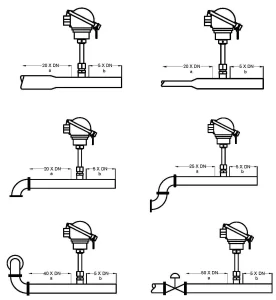
    The location of a flowmeter installation is crucial, but it is often ignored. It’s common to make a location decision solely on the basis of ease of installation. Before putting a flowmeter in place, the end-user should think about the flow disturbances in the region. As a result, consider carefully which site would be the most successful. In any case, once the position ( either vertical or horizontal or inclined ) has been determined, define the disturbances so that the manufacturer can decide if flow conditioning is necessary or not.
    insertion thermal mass flow meter in india
    thermal mass flow meter

    Number- 3: Flow conditioning requirements

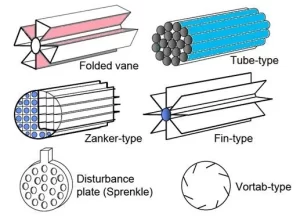
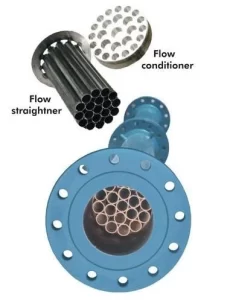
    In industrial processes the flow profile is affected by several disturbances upstream of the flowmeter. If appropriate straight length is unavailable for measurement performance, there is a need to install Flow conditioning device as an option upstream for better performance with less upstream length. Flow conditioners (also known as flow straighteners) may provide a consistent flow profile near the sensor.
    thermal mass flow meter in India leomi

    Number- 4: Process conditions

    In industrial processes flow sensor will be exposed to various process conditions such as temperature & pressure variations, condensation of gases, gas mixtures etc. should be informed to Thermal Mass flow meter manufacturers for consideration for compensating all possible factor while parameterization and calibration to ensure optimal accuracy of the flowmeter.

    Number- 5: Consideration in Flow sensor calibration

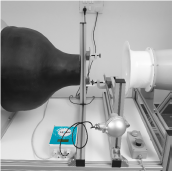
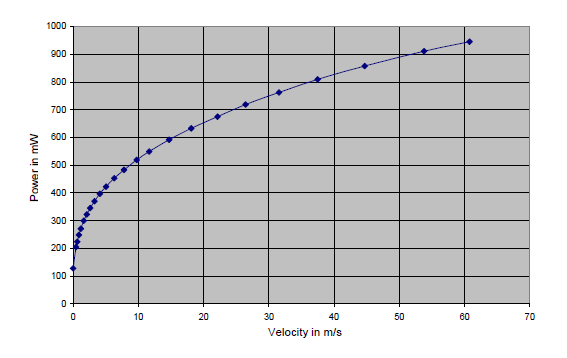
    The flowmeter sensor probe should be placed in the wind tunnel velocity chamber with uniform velocity. When using a thermal mass flow meter to measure a gas, it’s critical that the manufacturer understands the process conditions of the end user’s application. This allows the manufacturer to calibrate the instrument to the conditions of the application’s location. Flow rate in-accuracies will occur if this is not done. With a fully automatic calibration wind tunnel flow velocity versus sensor power is measured accurately programmed, to evaluate the relationship between mass flowrate and the signal for the gas and sensor under calibration, this step is repeated several times across the entire range.
    Thermal mass Flowmeter

    Conclusion

    When choosing a thermal mass flowmeter considering the above factors will ensure an optimal accuracy with desired performance.

    LEOMI Instruments from Gandhinagar, INDIA has developed proven technologies and wide-ranging solutions for thermal mass flow meters with recognition of Startup India. A make-in-India with manufacturing facility meeting German technology standards, that allows them to optimize the life of industrial processes, equipment, and machines.

    LEOMI’s products and expertise have helped flow measurement advancement in dozens of industrial applications including compressed air, combustion air, biogas, natural gas, flue gas, aeration air, corrosive process gases, and many more.

    Author: Manish Patel – Director Leomi India

  • India’s first In-house Fully Automatic Air Velocity Calibration as per ISO 17025

    India’s first In-house Fully Automatic Air Velocity Calibration as per ISO 17025

    Are you able to find a reliable manufacturer of Insertion Thermal Mass flowmeter with an In-house calibration facility in INDIA?

    Facing problem in validating/calibration of your existing Insertion Thermal Mass flowmeter, or Air velocity Instruments?

    Calorimetric airflow meter

    THEN, THIS ARTICLE IS FOR YOU.

    LEOMI has developed ways to optimize your existing air & gas flow measurement systems. LEOMI has newly commissioned India’s first in-house latest State-of-the-art Wind Tunnel, Made in Germany for Air Velocity Calibration and anemometer calibration services. It is certified as per ISO-17025 and DAkkS Germany traceability for air flow velocity ranges from 0.2 m/s to 75 m/s with flow uniformity of ±0.2%.

    The wind tunnel is constructed according to the Göttinger-type is a Closed designed circular tunnel with 180mm Nozzle diameter with 320mm open working section. Göttinger-type may be operated optionally using a closed section of measurements. The design requires low blower power and silence than other Eiffel-type wind tunnels.

    CALIBRATION AND TEST IN WIND TUNNEL UP TO 75M/S

    The wind tunnel is equipped with a precise flow calculation system that measures and control all functions as below:

    • the measurement of airflow velocity at the outlet of the nozzle with Prandtl-tube (high velocity) & thermal anemometer (low velocity)
    • Temperature, Relative humidity
    • Barometric pressure

    Flow calculation system uses multiple range differential pressure sensors for measurement of differential pressure across Prandtl type Pitot-static tube. The system uses a barometrical pressure sensor & temperature humidity sensor to calculate the actual density of the air. A special software (Lab View) uses these physical values to calculate the flow velocity at the outlet of the nozzle. For low velocity, a precise low-velocity thermal anemometer is used as a reference which is a switchover as velocity setpoints. The flow calculation system has a USB 2.0 interface to connect it to a computer.

    LEOMI DEVELOPS A PROPRIETARY CALIBRATION SOFTWARE 

    With a wind tunnel flow calculation system, Leomi developed a customized LabView-based calibration software that is capable of

    • measuring all data from wind tunnel flow calculation system via TCP/IP
    • measuring required parameters from the test instrument (Leomi-586) under calibration
    • recording system log of all wind tunnel parameters and test instrument
    • transfer calibration table to test instrument
    • preparing calibration protocol & printed
    • customize for other instruments calibration and test

    This customized software program is for controlling the wind tunnel and taking the measurement values of all sensors, included the calibrated sensor. All data will be completely recorded. Calculated data and status information will also be recorded. All relevant data are shown on the screen and add the calibrating curve. The calibrating is done completely under the control of this program. The curve in the following screenshot is the result of a calibration done completely without any influence of the user. After the calibration, the calculated data could be transferred to the calibrated unit. At last, after the calibration, a protocol will be printed.

    LEOMI a registered #startupindia company by DPIIT Government of India, LEOMI has developed Insertion Thermal Mass (Calorimetric) Flowmeters in India by technology transfer agreement from founders of Softflow.de, Germany. This will greatly help India for its self-sufficiency in such technology demand against import substitutes. Support us by being “Vocal for Local.”

    We just don’t stop here, LEOMI provide support for Air Velocity calibration services of other manufacturers’ product of various types of Air Velocity instruments, such as Insertion Thermal Mass Flowmeter, Hot-wire / Vane Anemometer, L Type & S Type Pitot Tube, etc.

  • Technology Advancements in Flow Measurement- Thermal Mass Flow Meter

    Technology Advancements in Flow Measurement- Thermal Mass Flow Meter

    Thermal mass flow meter technology is evolving and removing some of the challenges faced earlier.

    Thermal Mass Flow Meter deploys mainly two design working principles:

    CONSTANT TEMPERATURE ANEMOMETRY

    The constant-temperature sensor design maintains a constant temperature differential between a heated sensor and a reference sensor; the amount of power required to maintain the differential is measured as an indication of the mass flow rate. Constant-temperature thermal mass flowmeter currently popular with features as below:

    • Active
    • High-frequency response
    • The low electronic noise level
    • Immunity from sensor burnout when airflow suddenly drops
    • High rangeability
    • Compatible with various RTD Pt-100 sensors, such as hot thin film, wire wound, etc.
    • Applicability to gas flows

    CONSTANT POWER ANEMOMETRY

    Constant power sensor design maintains constant power between two temperature sensors which will provide a flow rate proportional to the temperature of the gas flows. This design is less popular and very limited usage due to technical limitations as below:

    • Passive, No feedback mechanism for any correction
    • No zero flow stability
    • Slow temperature & velocity response
    • Limited temperature compensation

    Thermal mass flow meter measurement technology is gaining respect in gas mass flow rate measurement in various applications ranging from very low flow rates to ultra-high flow rates accurately with the best turndown ratio, its versatility, ruggedness, no pressure drop, easy installation against some of the conventional technologies such as Orifice, Aerofoil, Pitot-tube, Turbine & Vortex, etc.

    Thermal mass flow measurement is realized in different ways and flowmeter types for satisfying different industrial needs such as

    • Laboratory style (with By-pass principle) for analytical & research purpose for
    • Inline Industrial style for intermediate pipe sizes from 15mm to 150mm generally
    • Insertion style for larger pipe sizes, etc.

    Today’s process industries demand measurement technologies which are fairly priced and will help in optimizing process efficiency for reducing environmental emissions. To meet such demand, the manufacturers are focusing on the research and development of thermal mass flow sensor technology and its solutions concerning application expectations against other technologies.

    For harsh applications customized Insertion Thermal Mass Flow Meters are available. Process gases stack emissions are corrosive. Chemical industries have to follow emission norms and measure the flow for this. It is impossible to measure the flow with conventional technologies. This has many challenges in measurement such as material compatibility & cost of ownership.

    Manufacturers like LEOMI offer the following solutions

    • HALAR® (ECTFE) coated for corrosive gases up to 100°C (max) and
    • PFA Coated for Hot flue gas & corrosive process gases up to 200°C (max)

    These advancements are an alternative to costlier Hastelloy C276 Insertion thermal mass flow meter made or other special metal grades if any.

    Other air flow meter advancement includes solutions for hot application with corrosive fumes, unknown waste-gas and gas traces in large duct with low-pressure gas mass flow measurement

    FOR MORE INFORMATION ON THERMAL MASS FLOW MEASUREMENT, YOU MAY CONTACT LEOMI.
  • LEOMI 586 vs Thin Film Flow sensor

    LEOMI-586 THERMAL FLOW SENSOR OR THIN-FILM FLOW SENSOR TECHNOLOGIES?? CHOOSE WISELY!

    There are various types of thermal flow velocity sensors available in markets based on proprietary designs concerning application requirements and customer price expectations.

    The thermal mass flow meter sensor uses RTD Pt-100 elements for measuring flow velocity.

    Mainly two types of RTD Pt-100 elements are used to produce thermal flow sensor:

    • The platinum wire of a ceramic wire-wound RTD Pt100 sensor is wound into a small coil that is inserted into the holes of a high purity alumina tube. The ODs of these high purity alumina tube varies from 0.8 mm to 4.5 mm, so they are even suitable for the thinnest RTD mineral insulated cables. It is quite expensive than thin-film resistors.
    • Thin-film RTDs are platinum elements that are constructed by placing a sensing platinum layer over a ceramic substrate, covered with passivation glass layers. This results in excellent shock and vibration resistance and protects the Pt sensor element from environmental influences. It is quite cheaper than ceramic wire wound resistors.

    Leomi-586 uses a ceramic wire wound RTD Pt-100 sensor with a specialized encapsulation process for the best performance for almost every type of application.

    Customer’s process conditions determine which type of thermal flow sensor is better for the application as each has its pros and cons.

    LEOMI-586 FLOW SENSOR ADVANTAGES USING CERAMIC WIRE-WOUND RESISTORS

    • High accuracy better than ±1.5% of reading of along the entire temperature range
    • High dynamic range & resolution
    • Wide temperature ranges -40°C to 500°C
    • Designed with lead length compensation
    • High powered & high differential temperature ranges possible
    • Rugged & drift-free
    • Unaffected by moisture, dirt

    LEOMI-586 FLOW SENSOR DISADVANTAGES USING WIRE-WOUND RESISTORS

    • Larger footprint in length up to 25mm
    • Highly expensive than flow sensor made from thin-film resistors

    THERMAL FLOW SENSOR ADVANTAGES USING THIN-FILM RESISTORS

    • Compact size (around 3mm, or 1/8-inch) in length
    • Vibration resistance due to smaller mass and size
    • Tip-sensitive sensor construction
    • Cheaper than a ceramic wire-wound flow sensor

    THERMAL FLOW SENSOR DISADVANTAGES USING THIN-FILM RESISTORS:

    • Loss of accuracy ±3% of reading at low and high temperatures
    • Works up to 60°C temperatures
    • Low power and low differential temperature range
    • Lower dynamic range & resolutions
    • High drift due to moisture, dirt, and dust
    • No lead length compensation

    FIND HERE, WHY YOU SHOULD CHOOSE LEOMI-586 OVER OTHER THIN FILM FLOW TECHNOLOGIES???

    LEOMI to serve various process industries rugged application developed various types of thermal flow sensors in SS-316Ti, Haste alloy C276, HALAR® coated, PFA coated construction to meets challenging demands. It has robust construction & a rugged flow-sensor design with Pt-100 RTD ceramic wire-wound sensor which provides stable output non-drift, vibration resistant encapsulation, and mechanically strong than thin-film flow sensor.

    Leomi with proven design from (formerly SF-586b) Leomi-586 Insertion Thermal mass flow meter utilizes a combination of an analog controller for high resolution & quick action and digital controller for very high absolute accuracy and long-term stability against the disadvantages of a wheat stone bridge.

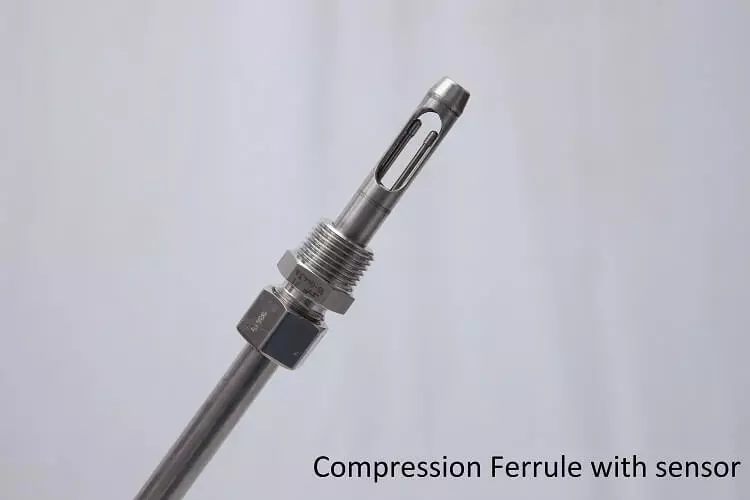
    Compression-Ferrule-with-air flow sensor

    LEOMI 586 thermal mass flow sensor with all above merits a preferred choice for any simple or rugged application with accurate, repeatable & stable than thin-film flow sensor. LEOMI provides sensors that can be easily operated even in corrosive gases with HALAR®& PFA coatings upon requests.

    For any queries drop us an email will be happy to assist you.

    From simple airflow velocity transmitter at room conditions needs economical design which uses thin-film resistors whereas application such as hot air or flue gas demands for rugged flow velocity sensor design which has many other technical considerations of high temperature, corrosion, dirt, moisture, dust to be taken into account for performance.

    Thin film-based flow sensors are used bare & un-capsulated whereas Leomi-586 flow sensor used for harsh process gases used with various metallic encapsulated for their long term performance.

    Economical thin-film flow sensors are mainly used for ventilation air, compressed air which is low powered sensor generally flow velocity measurement is done with wheat stone bridge circuitry arrangement which is prone to electrical drifting, no lead length compensation, difficult adjustment of sensors apart from this corrosion due to moisture, sensor drift due to dirt, mechanical vulnerability and many more. So, it ultimately affects the stability, accuracy & life of the flow sensor.