Category: Social Media Blogs

  • Thermal Mass flow measurement for beverage production & Chilling

    Thermal Mass flow measurement for beverage production & Chilling

    Thermal Mass Flow Meter For Beverage Production

    Food & Beverage industry production has various processes depending upon raw materials such as juice concentrates, grains, milk products. The typical process involves cleaning, blending, sterilization, fermentation, drying, cooling, filtration, packaging of the finished products.

    In various processes compressed airplay’s a vital role in conveying raw materials and also steam boiler for the heating & sterilization process is of prime importance. Also, the wastewater treatment process also needs to be optimized. Organic waste in the food & beverage wastewater treatment process generates biogas which is recovered for use in Boiler fuel.

    LEOMI WITH ITS INSERTION THERMAL MASS FLOW METER RANGE HELPS TO OPTIMIZE THE F&B PRODUCTION PROCESS

    • Monitoring & control of Compressed air used in various processes & saving energy
    • Ideal monitoring of low-pressure Biogas generated in wastewater treatment
    • Boiler Air-fuel ratio control for optimum boiler efficiency
    • Aeration air flow through diffuser membrane system to optimize dissolved oxygen rate
  • Measure gas flow in wastewater plants

    Measure gas flow in wastewater plants

    Gas Flow in Wastewater Treatment Plants

    Thanks to modern technology, a wastewater treatment plant has now been able to measure and record the waste gas flowing from the digesters (aka the fermenter room) to the boiler room burners and to a flare stack in real-time. This helps them monitor how well they’re able to handle their wastes while guaranteeing that they don’t violate environmental standards.

    Due to environmental reasons, Sewage generated on-board cannot be discharged to the sea without proper treatment.

    Most often onboard sewage treatment plants rely on biological Decomposition. Flow measurement at various stages of the plant is crucial to ensure an efficient process.

    Thermal mass flow meters provide accurate gas flow measurement and monitoring of air, oxygen, ozone, and digester gases present in wastewater treatment plants.

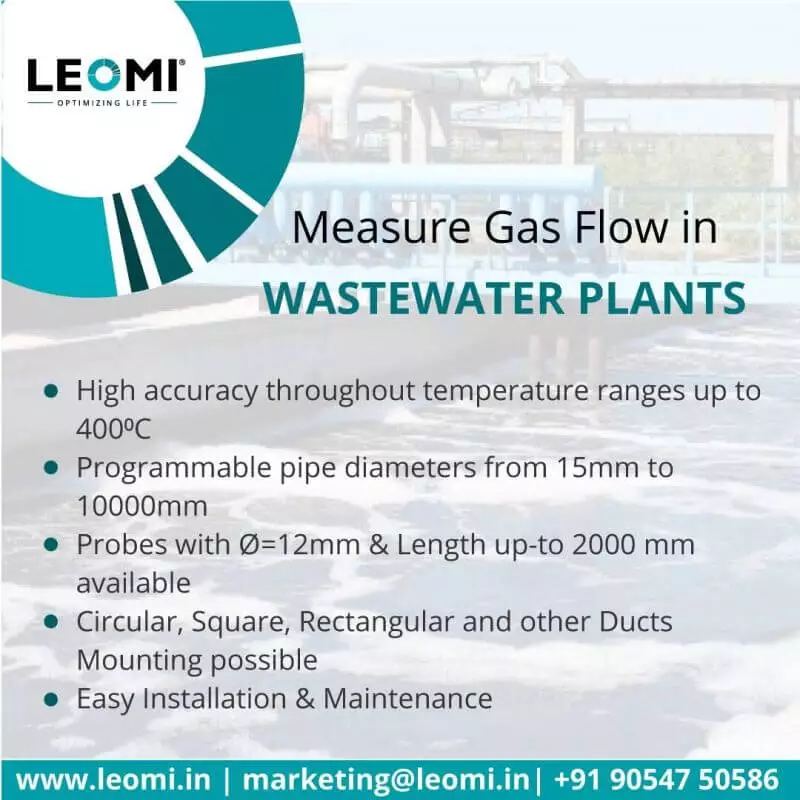
    Leomi Thermal Mass Flowmeter has below features that help you to get an accurate measurement of wastewater :

    • High accuracy throughout temperature ranges up to 400⁰C
    • Programmable pipe diameters from 15 mm to 10000 mm
    • Probes with Ø=12mm & Lengths up to 2000 mm are available
    • Circular, Square, Rectangular, and other ducts mounting possible
    • Easy Installation & maintenance
    • Integration in the data network with different data converters is possible
    • In-built standard gas database for a selection.
  • Thermal mass flow meter for aeration air application

    Thermal mass flow meter for aeration air application

    Thermal Mass flow meter for aeration air

    Thermal Mass Flow Meter :

    A thermal mass flow meter is an easy-to-use tool one must have if they’d like to accurately check air pollution levels at a wastewater treatment plant. Choosing a thermal mass flow meter for their aeration system allows the people who work at the plant to calculate their energy needs more easily and manage their energy consumption in more efficient ways so that they can save money on electricity bills but also lessen their carbon footprint.

    Aeration lane air controls are the most imperative as lower or no air supply causes bacterial death due to starvation for oxygen & inefficient treatment whereas very high air supply increases too much bacterial growth in-turn bacteria gets hungry and dies & also increase energy cost.

    Air flow meters come in handy for optimizing aeration control by measuring aeration airflow to address the need to control oxygen flow rate requirements for optimizing BOD & Energy cost in Effluent Water Treatment Plant.

    LEOMI thermal dispersion technology is the supported innovation for measuring aeration airflow at plants where wastewater is dealt with Large scale Municipal Sewage Treatment, Common Effluent Treatment Plants (CETP), small industrial effluent treatment.

  • HVAC system air flow monitoring in nuclear power plant

    HVAC system air flow monitoring in nuclear power plant

    Airflow monitoring in nuclear power plant

    In a Air Flow Monitoring in Nuclear Power Plant

    efficient HVAC systems supply & exhaust airflow rate plays an important
    role in monitoring the release of air from controlled areas and contain any
    radioactivity that might be released in the event of a malfunction, failure, or
    accident.

    The high sensitive thermal mass flow meter is an
    ideal choice & detects leakages from the duct.

    HVAC system is of utmost importance considering
    safety & smooth operations by maintaining ambient conditions within
    acceptable limits.

    In addition, these systems help protect staff
    and equipment from specific risks inside the buildings, such as explosions or
    fire.

  • Pros & Cons of Coriolis Flow Meter

    Pros & Cons of Coriolis Flow Meter

    gas flow measurement technologies

    Pros and Cons of different gas flow measurement technologies available in the market which will help process instrumentation engineers to effectively choose best flow metering technology for defined application which results in optimum results w.r.t cost versus performance ratio.

    Process instrumentation engineer’s task is to identify which of the Mass flow meter technology will be best suitable technology.

    Below are some important factors to be considered & evaluated with comparing technologies for  ptimum selections:

    • Pipe sizes
    • Process conditions such as flowrate, pressure, temperature, density, viscosity, dirt & moisture etc.
    • Installation conditions such as horizontal, vertical or inclined & available straight lengths, time & efforts etc.
    • Accuracy & repeatability needed
    • Process turndown ratio needed
    • Budgeted price

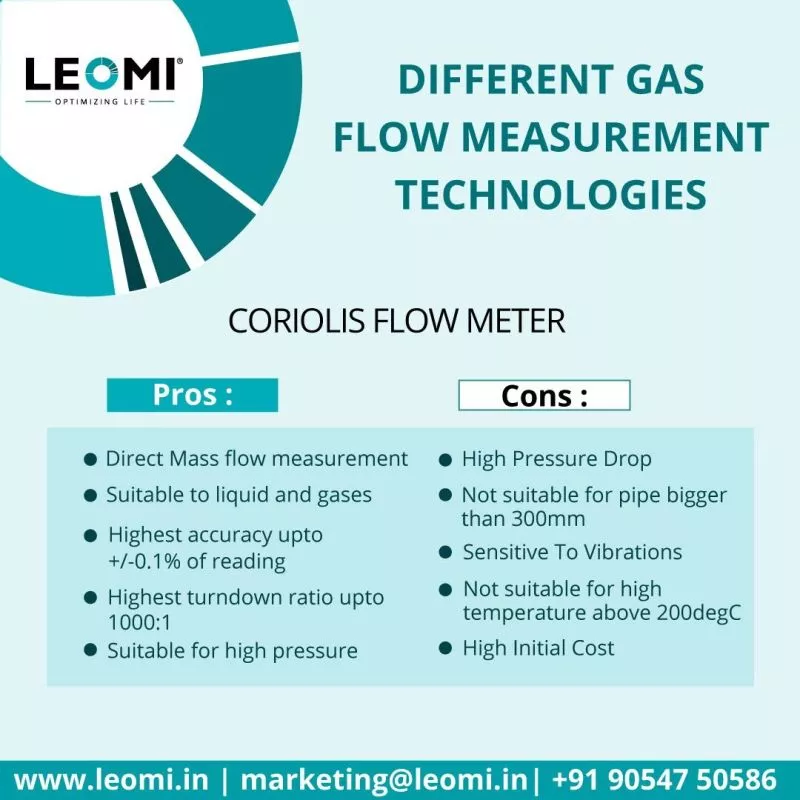
    Here are the advantages and disadvantages of Coriolis Flow Meter.

    Pros :

    1. Direct Mass Flow Measurement
    2. Suitable to Liquid and Gases
    3. Highest accuracy
    4. Highest turn down ratio
    5. Suitable for high pressure

    Cons :

    1. High-pressure drop
    2. Sensitive to vibrations
    3. Not suitable for high temperature
    4. High initial cost
  • How Selecting the right flowmeter can help you minimize your annual energy costs

    How Selecting the right flowmeter can help you minimize your annual energy costs

    airflow meter in india

    The pace of the liquid stream establishes a significant estimation in the handling enterprises.

    Choosing a fitting innovation for a stream estimation application can subsequently be an overwhelming assignment. With such a wide assortment of innovations on offer, it very well may be hard to track down the best one for a specific application. Les Slocombe, for ABB Measurement Products UK, clarifies how finding the flowmeter that can make the greatest commitment to limiting energy expenses can assist with restricting the choice.

    The broad decision of stream innovation choices on proposition can make choosing the right flowmeter for an application a stupefying assignment. A wide scope of variables can impact air flow meter choice, of which cost is only one. Flowmeters dependent on differential strain opening plates, spouts, wedges, Venturis, and Pitot tubes present a limitation in the stream. The unrecoverable strain misfortune brought about by the limitation is a proportion of the volumetric stream rate. Positive removal flowmeters are valid volumetric stream gadgets, estimating the real liquid volume that goes through a meter body with no worry for speed. These flowmeters catch a particular volume of liquid and pass it to the power source. The liquid tension moves the system that exhausts one chamber as another fills.
    In case the application requires a proportion of the mass stream rate, volumetric flowmeters should be enhanced with extra data, like liquid thickness, pressure, as well as temperature. Some multivariable flowmeters and transmitters fuse an extra sensor to give this data. Then again, Coriolis flowmeters (and warm tests for gas) straightforwardly measure mass stream rate. With a current portion of the overall industry of around 18%, they are consistently tracking down their direction into an expanding scope of utilizations. Many flowmeter technologies introduce pressure loss into a system. Pressure losses equate to energy losses and costs. Valves, pipe friction, reducers, expanders, and measuring devices such as flowmeters all increase the Permanent Pressure Loss (PPL) in the system. Some flowmeters require upstream reducers and downstream expanders to operate properly. For new processes, engineers often consider PPL when designing a system because it’s important in sizing the pump (liquids), compressor (gases), or boiler (steam) to meet process conditions and to deliver the desired pressure and/or flow. For operating processes, PPL leads directly to the need for compensating energy, which can equate to significantly increased annual operating costs. By minimizing pressure losses in a process, engineers can cut the need for top-up pumping or compression as well as environmental impact. In the case of steam boilers, which are expensive, the ability to retrofit existing flowmeters with those having low-pressure losses can boost the effective boiler capacity.

    By selecting air flow meters with low-pressure losses, engineers can:

    – Reduce pumping/compressing cost
    – Increase capacity
    – Minimize compressor, pump, or boiler size. The amount of pressure loss in a flowmeter depends on three factors: the fluid density, the square of the fluid velocity (Vf)2, and the degree of obstruction to fluid flow, (Kmeter).

    The following list roughly ranks the magnitude of the Kmeter factor for various air flow meters, from greatest pressure loss to lowest.

    1. Coriolis
    2. Orifice/Nozzle
    3. Turbine
    4. Vortex
    5. Venturi
    6. Averaging Pitot tube
    7. Electromagnetic/Ultrasonic (negligible PPL)

    Replacing an orifice plate with an averaging Pitot tube, for example, can reduce the permanent pressure loss (energy requirement) by a factor of 20. Averaging Pitot tubes offer minimal irrecoverable pressure losses as well as being inexpensive and simple to install.

  • Pros & Cons of Thermal Mass Flow Meter

    Pros & Cons of Thermal Mass Flow Meter

    gas flow meter in India

    Pros and Cons of different gas flow measurement technologies available in the market which will
    help process instrumentation engineers to effectively choose the best flow metering technology for defined application which results in optimum results w.r.t cost versus performance ratio.

    Process instrumentation engineer’s task is to identify which of the Mass flow meter technology will be the best suitable technology.

    Below are some important factors to be considered & evaluated with comparing technologies for optimum selections:

    – Pipe sizes
    – Process conditions such as flow rate, pressure, temperature, density, viscosity, dirt & moisture, etc.
    – Installation conditions such as horizontal, vertical or inclined & available straight lengths, time & efforts etc.
    – Accuracy & repeatability needed
    – Process turndown ratio needed
    – Budgeted price

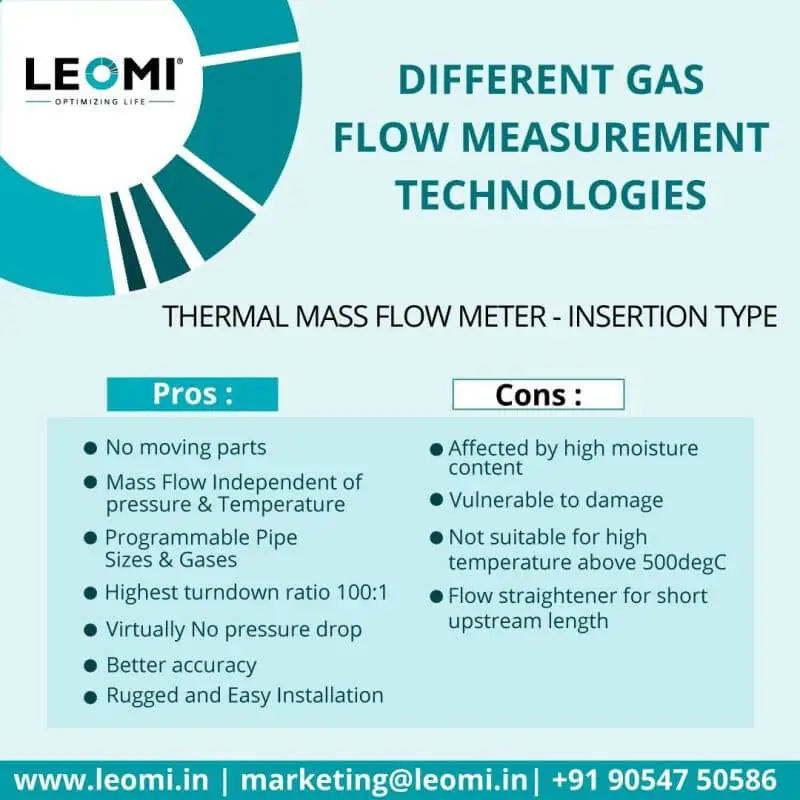
    Here are the pros and Cons of Thermal Mass Flow Meter – Insertion Type

    Pros:
    1. No moving parts
    2. Independent mass flow
    3. Pipe size
    4. Highest turndown ratio
    5. Virtually no pressure drop
    6. Better accuracy
    7. Easy installation & rugged

    Cons:
    1. Affected by high moisture content
    2. Vulnerable to damage
    3. Not suitable for high temperature
    4. Flow straightener for short upstream length

  • Pros & Cons of Turbine Flow Meter

    Pros & Cons of Turbine Flow Meter

    Pros and Cons of different gas flow measurement technologies available in the market which will help process instrumentation engineers to effectively choose best flow metering technology for defined application which results in optimum results w.r.t cost versus performance ratio.


    Process instrumentation engineer’s task is to identify which of the Mass flow meter technology will be best suitable technology.


    Below are some important factors to be considered & evaluated with comparing technologies for optimum selections:


    – Pipe sizes

    – Process conditions such as flowrate, pressure, temperature, density, viscosity, dirt & moisture etc.

    – Installation conditions such as horizontal, vertical or inclined & available straight lengths, time & efforts etc.

    – Accuracy & repeatability needed

    – Process turndown ratio needed

    – Budgeted price


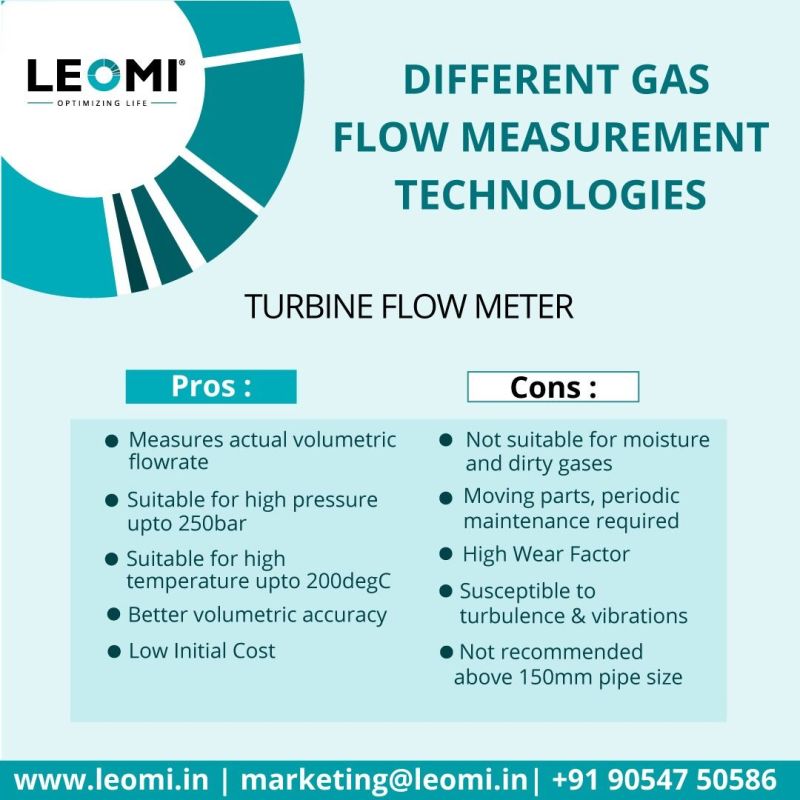
    Here are the Pros and Cons of a Turbine Flow Meter :


    Pros :

    1. Derives Volumetric Flow rate

    2. High accuracy

    3. Orientation Flexible

    4. Low Initial Cost

    5. Suitable High pressure


    Cons :

    1. Dry and Clean Gas

    2. Susceptible to Vibrations

    3. High wear factor


  • Pros & Cons of Ultrasonic Flow Meter

    Pros & Cons of Ultrasonic Flow Meter

    Pros and Cons of different gas flow measurement technologies available in the market will help process instrumentation engineers to effectively choose best flow metering technology for defined application which results in optimum results w.r.t cost versus performance ratio.

    Process instrumentation engineer’s task is to identify which of the Mass flow meter technology will be best suitable technology.

    Below are some important factors to be considered & evaluated with comparing technologies for optimum selections:

    – Pipe sizes
    – Process conditions such as flow rate, pressure, temperature, density, viscosity, dirt & moisture, etc.
    – Installation conditions such as horizontal, vertical, or inclined & available straight lengths, time & efforts, etc.
    – Accuracy & repeatability needed
    – Process turn down ratio needed
    – Budgeted price

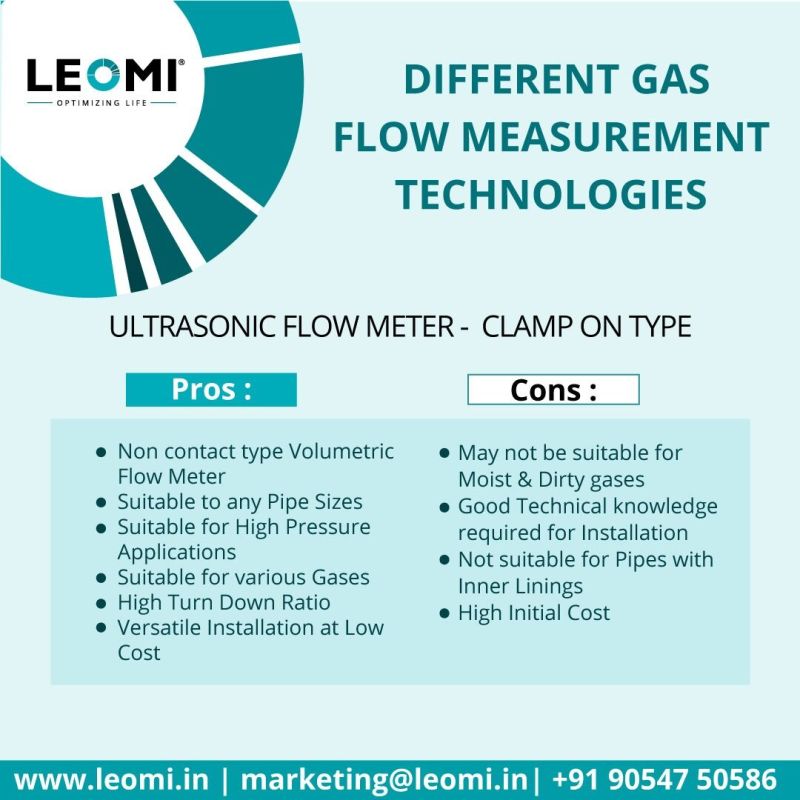
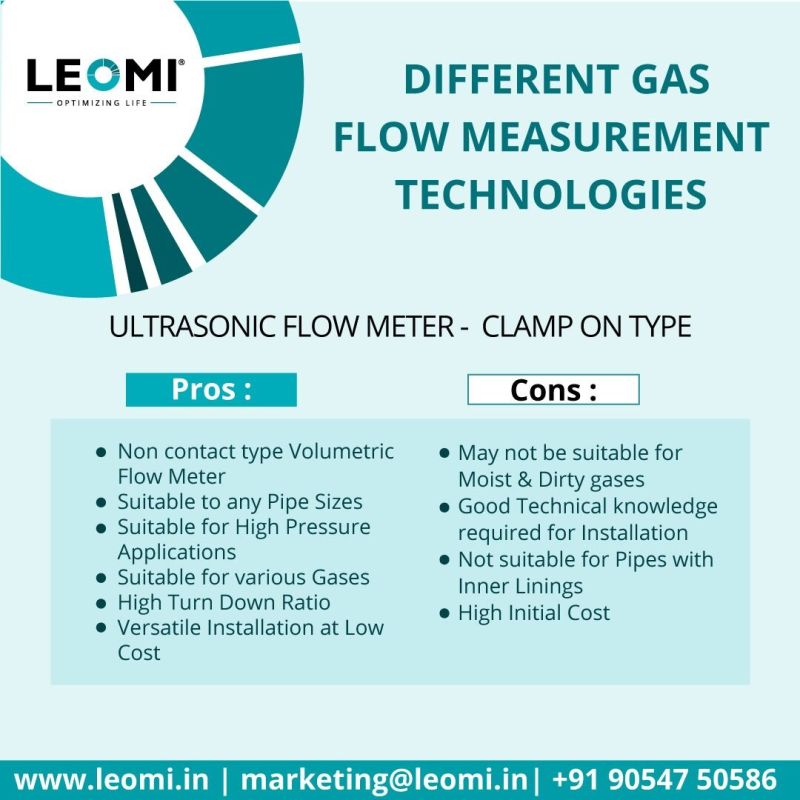
    Here are the Pros and Cons of Ultrasonic Flow Meter- Clamp-on Type

    Pros :
    1. Non-contact type volumetric flow meter
    2. Suitable 5o any pipe sizes
    3. Suitable to high pressure
    4. High turn down ratio

    Cons :
    1. May be not Suitable for moist and dirty gases
    2. High initial cost
    3. Most Suitable for pipes with inner lining

  • Pros & Cons of Vortex Flow Meter

    Pros & Cons of Vortex Flow Meter

    Pros and Cons of different gas flow measurement technologies available in the market which will help process instrumentation engineers to effectively choose best flow metering technology for defined application which results in optimum results w.r.t cost versus performance ratio.

    Process instrumentation engineer’s task is to identify which of the Mass flow meter technology will be best suitable technology.

    Below are some important factors to be considered & evaluated with comparing technologies for optimum selections:

    – Pipe sizes
    – Process conditions such as flowrate, pressure, temperature, density, viscosity, dirt & moisture etc.
    – Installation conditions such as horizontal, vertical or inclined & available straight lengths, time & efforts etc.
    – Accuracy & repeatability needed
    – Process turndown ratio needed
    – Budgeted price

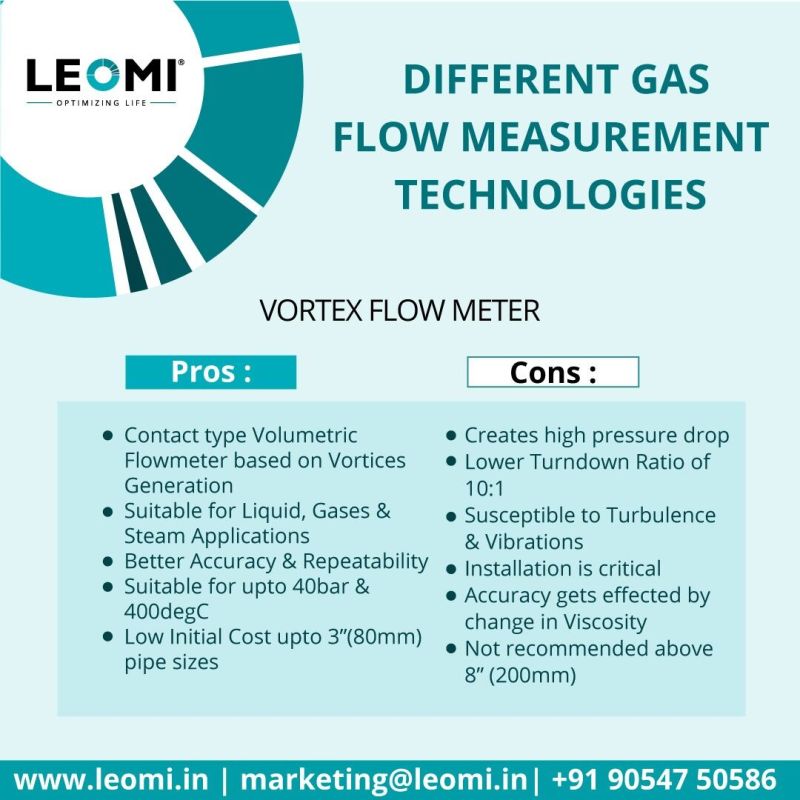
    Here are the Pros and Cons of Vortex Flow Meter

    Pros :
    1. Suitable for liquid, gases and steam applications
    2. Better accuracy and repeatability
    3. Low initial cost
    4. Suitable upto 40 bar

    Cons :
    1. Creates high pressure drop
    2. Susceptible to turbulent and vibration
    3. Accuracy gets affected due to viscosity