Day: February 17, 2020

  • Thermal Mass Flow Meter Industry and COVID-19 Assessment

    Thermal Mass Flow Meter Industry and COVID-19 Assessment


    Thermal Mass Flow Meter Industry and COVID-19 Assessment News, 2020-2025

    The Global flow meter market was valued at USD USD7.7 billion in the year 2019.

    The rise in the transmission & distribution of gas by the growing number of new facilities has fuelled the growth of flow control systems. Manufacturers are focusing on innovating mass flow meter applications in food & beverage, thermal power plants and textile industries. However, the center of focus is growing number of gas exploration projects around the world.

    Demand for thermal mass flowmeter is expected to rise during the forecast period, as it is a cost-effective technology and owing to its usage in various applications specific industries such as oil & gas and power sectors. Also, expansion of the energy industry across the globe is a key factor driving the global thermal mass flow meter market. Moreover, recent development of multi-path meters and rising demand for flowmeters for custody transfer applications are key factors fueling the global thermal mass flowmeter market.

    However, world trade is expected to fall by between 13% and 32% in 2020 as the COVID 19 pandemic disrupts normal economic activity and life around the globe. Regional outbreak, weaker global demand, financial market volatility and lower oil prices will undermine consumption, investment and exports and hampering many industries including the thermal mass flowmeter market, at least in the year 2020.

  • Technology Advancements in Flow Measurement- Thermal Mass Flow Meter

    Technology Advancements in Flow Measurement- Thermal Mass Flow Meter

    Thermal mass flow meter technology is evolving and removing some of the challenges faced earlier.

    Thermal Mass Flow Meter deploys mainly two design working principles:

    CONSTANT TEMPERATURE ANEMOMETRY

    The constant-temperature sensor design maintains a constant temperature differential between a heated sensor and a reference sensor; the amount of power required to maintain the differential is measured as an indication of the mass flow rate. Constant-temperature thermal mass flowmeter currently popular with features as below:

    • Active
    • High-frequency response
    • The low electronic noise level
    • Immunity from sensor burnout when airflow suddenly drops
    • High rangeability
    • Compatible with various RTD Pt-100 sensors, such as hot thin film, wire wound, etc.
    • Applicability to gas flows

    CONSTANT POWER ANEMOMETRY

    Constant power sensor design maintains constant power between two temperature sensors which will provide a flow rate proportional to the temperature of the gas flows. This design is less popular and very limited usage due to technical limitations as below:

    • Passive, No feedback mechanism for any correction
    • No zero flow stability
    • Slow temperature & velocity response
    • Limited temperature compensation

    Thermal mass flow meter measurement technology is gaining respect in gas mass flow rate measurement in various applications ranging from very low flow rates to ultra-high flow rates accurately with the best turndown ratio, its versatility, ruggedness, no pressure drop, easy installation against some of the conventional technologies such as Orifice, Aerofoil, Pitot-tube, Turbine & Vortex, etc.

    Thermal mass flow measurement is realized in different ways and flowmeter types for satisfying different industrial needs such as

    • Laboratory style (with By-pass principle) for analytical & research purpose for
    • Inline Industrial style for intermediate pipe sizes from 15mm to 150mm generally
    • Insertion style for larger pipe sizes, etc.

    Today’s process industries demand measurement technologies which are fairly priced and will help in optimizing process efficiency for reducing environmental emissions. To meet such demand, the manufacturers are focusing on the research and development of thermal mass flow sensor technology and its solutions concerning application expectations against other technologies.

    For harsh applications customized Insertion Thermal Mass Flow Meters are available. Process gases stack emissions are corrosive. Chemical industries have to follow emission norms and measure the flow for this. It is impossible to measure the flow with conventional technologies. This has many challenges in measurement such as material compatibility & cost of ownership.

    Manufacturers like LEOMI offer the following solutions

    • HALAR® (ECTFE) coated for corrosive gases up to 100°C (max) and
    • PFA Coated for Hot flue gas & corrosive process gases up to 200°C (max)

    These advancements are an alternative to costlier Hastelloy C276 Insertion thermal mass flow meter made or other special metal grades if any.

    Other air flow meter advancement includes solutions for hot application with corrosive fumes, unknown waste-gas and gas traces in large duct with low-pressure gas mass flow measurement

    FOR MORE INFORMATION ON THERMAL MASS FLOW MEASUREMENT, YOU MAY CONTACT LEOMI.
  • LEOMI 586 vs Thin Film Flow sensor

    LEOMI-586 THERMAL FLOW SENSOR OR THIN-FILM FLOW SENSOR TECHNOLOGIES?? CHOOSE WISELY!

    There are various types of thermal flow velocity sensors available in markets based on proprietary designs concerning application requirements and customer price expectations.

    The thermal mass flow meter sensor uses RTD Pt-100 elements for measuring flow velocity.

    Mainly two types of RTD Pt-100 elements are used to produce thermal flow sensor:

    • The platinum wire of a ceramic wire-wound RTD Pt100 sensor is wound into a small coil that is inserted into the holes of a high purity alumina tube. The ODs of these high purity alumina tube varies from 0.8 mm to 4.5 mm, so they are even suitable for the thinnest RTD mineral insulated cables. It is quite expensive than thin-film resistors.
    • Thin-film RTDs are platinum elements that are constructed by placing a sensing platinum layer over a ceramic substrate, covered with passivation glass layers. This results in excellent shock and vibration resistance and protects the Pt sensor element from environmental influences. It is quite cheaper than ceramic wire wound resistors.

    Leomi-586 uses a ceramic wire wound RTD Pt-100 sensor with a specialized encapsulation process for the best performance for almost every type of application.

    Customer’s process conditions determine which type of thermal flow sensor is better for the application as each has its pros and cons.

    LEOMI-586 FLOW SENSOR ADVANTAGES USING CERAMIC WIRE-WOUND RESISTORS

    • High accuracy better than ±1.5% of reading of along the entire temperature range
    • High dynamic range & resolution
    • Wide temperature ranges -40°C to 500°C
    • Designed with lead length compensation
    • High powered & high differential temperature ranges possible
    • Rugged & drift-free
    • Unaffected by moisture, dirt

    LEOMI-586 FLOW SENSOR DISADVANTAGES USING WIRE-WOUND RESISTORS

    • Larger footprint in length up to 25mm
    • Highly expensive than flow sensor made from thin-film resistors

    THERMAL FLOW SENSOR ADVANTAGES USING THIN-FILM RESISTORS

    • Compact size (around 3mm, or 1/8-inch) in length
    • Vibration resistance due to smaller mass and size
    • Tip-sensitive sensor construction
    • Cheaper than a ceramic wire-wound flow sensor

    THERMAL FLOW SENSOR DISADVANTAGES USING THIN-FILM RESISTORS:

    • Loss of accuracy ±3% of reading at low and high temperatures
    • Works up to 60°C temperatures
    • Low power and low differential temperature range
    • Lower dynamic range & resolutions
    • High drift due to moisture, dirt, and dust
    • No lead length compensation

    FIND HERE, WHY YOU SHOULD CHOOSE LEOMI-586 OVER OTHER THIN FILM FLOW TECHNOLOGIES???

    LEOMI to serve various process industries rugged application developed various types of thermal flow sensors in SS-316Ti, Haste alloy C276, HALAR® coated, PFA coated construction to meets challenging demands. It has robust construction & a rugged flow-sensor design with Pt-100 RTD ceramic wire-wound sensor which provides stable output non-drift, vibration resistant encapsulation, and mechanically strong than thin-film flow sensor.

    Leomi with proven design from (formerly SF-586b) Leomi-586 Insertion Thermal mass flow meter utilizes a combination of an analog controller for high resolution & quick action and digital controller for very high absolute accuracy and long-term stability against the disadvantages of a wheat stone bridge.
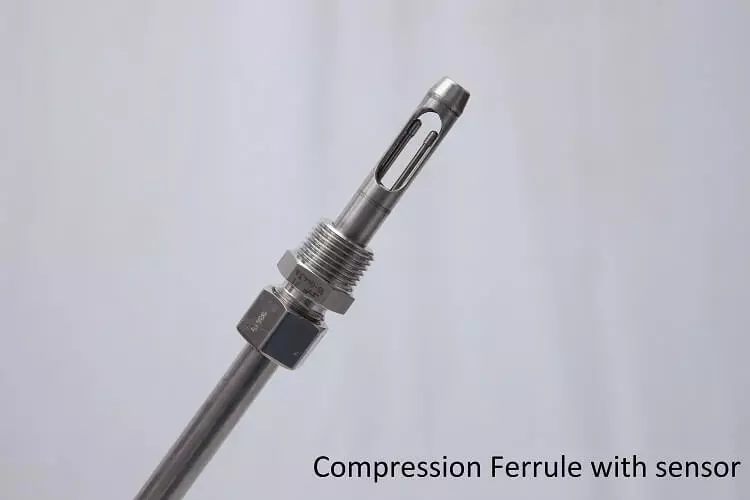
    Compression-Ferrule-with-air flow sensor

    LEOMI 586 thermal mass flow sensor with all above merits a preferred choice for any simple or rugged application with accurate, repeatable & stable than thin-film flow sensor. LEOMI provides sensors that can be easily operated even in corrosive gases with HALAR®& PFA coatings upon requests.

    For any queries drop us an email will be happy to assist you.

    From simple airflow velocity transmitter at room conditions needs economical design which uses thin-film resistors whereas application such as hot air or flue gas demands for rugged flow velocity sensor design which has many other technical considerations of high temperature, corrosion, dirt, moisture, dust to be taken into account for performance.

    Thin film-based flow sensors are used bare & un-capsulated whereas Leomi-586 flow sensor used for harsh process gases used with various metallic encapsulated for their long term performance.

    Economical thin-film flow sensors are mainly used for ventilation air, compressed air which is low powered sensor generally flow velocity measurement is done with wheat stone bridge circuitry arrangement which is prone to electrical drifting, no lead length compensation, difficult adjustment of sensors apart from this corrosion due to moisture, sensor drift due to dirt, mechanical vulnerability and many more. So, it ultimately affects the stability, accuracy & life of the flow sensor.